
Home >>Local
Puyang moves to modernize manufacturing sector
Source:China Daily
Published:2026-03-11 09:42
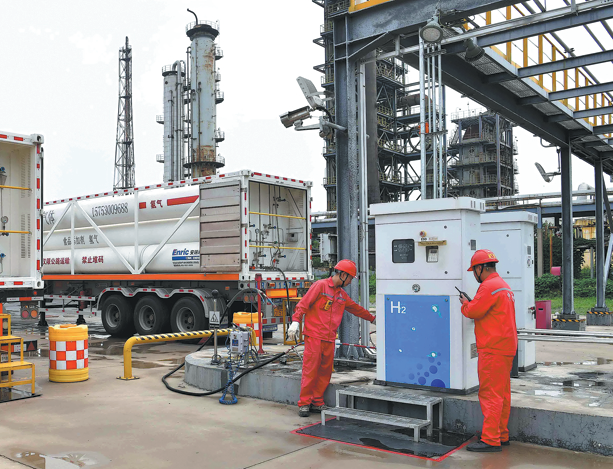
Personnel from Sinopec Zhongyuan Oilfield Company pump hydrogen into a vehicle at a hydrogen production workshop in Puyang, Henan province, on Aug 12, 2024. TONG JIANG/FOR CHINA DAILY
In a strategic pivot emblematic of China's broader industrial ambitions, Puyang in Henan province is aggressively reshaping its economic landscape, pivoting from a reliance on depleted resources toward a future defined by advanced manufacturing and sustainable practices, according to its top official.
Wan Zhengfeng, a deputy to the National People's Congress and Party secretary of Puyang, said this transformation is centered on the development of six major industrial clusters and 20 key supply chains, a drive that has seen local manufacturing "chase innovation and go green".
The 2026 Government Work Report said: "We should stay focused on the real economy, develop new quality productive forces in light of local conditions, and modernize the industrial system."
According to Wan, the city is steadfastly implementing the strategy of "prospering the city through industry and strengthening the city through manufacturing." The goal is to build a modern industrial system by focusing on the high-quality development of the manufacturing sector.
Puyang's journey is one of necessity. Born and sustained by the oil industry for decades, the city was designated a resource-exhausted city as extraction became more difficult and output declined. This challenge forced a difficult transformation.
"The entire city has made strengthening key industrial chains and clusters, and promoting manufacturing development, a key task in building a modernized Puyang,"Wan said.
The city's approach is systematic and multipronged. At its heart is the focused cultivation of six advanced manufacturing clusters — including new materials and new energy — and 20 key industrial chains, such as bio-based materials and hydrogen energy, he said.
This strategy is designed to propel the industrial ecosystem from "single-point breakthroughs" to "cluster synergy", pushing manufacturing toward the higher end of the value chain.
Wan detailed a strategy for this high-quality development, including enhancing economic efficiency through transformation and synergy, stimulating innovation through scientific research and development, and accelerating industrial agglomeration through a cluster and chain-based approach.
A critical component of this industrial renaissance is digitization. Puyang is using digital empowerment to comprehensively upgrade the high-end, intelligent, and green aspects of its manufacturing sector. This push has ensured a consistently positive trajectory for the city's industrial economy.
In 2025, Puyang's GDP reached 210.6 billion yuan ($30.4 billion), with a growth rate of 5.6 percent. Industrial investment increased by 23.9 percent and manufacturing investment grew by 20.1 percent.
Editor:Zhou Jinmiao