
Home >>Local
Ancient Chinese civilization breathes life into the economy
Source:China Daily
Published:2026-05-11 11:32
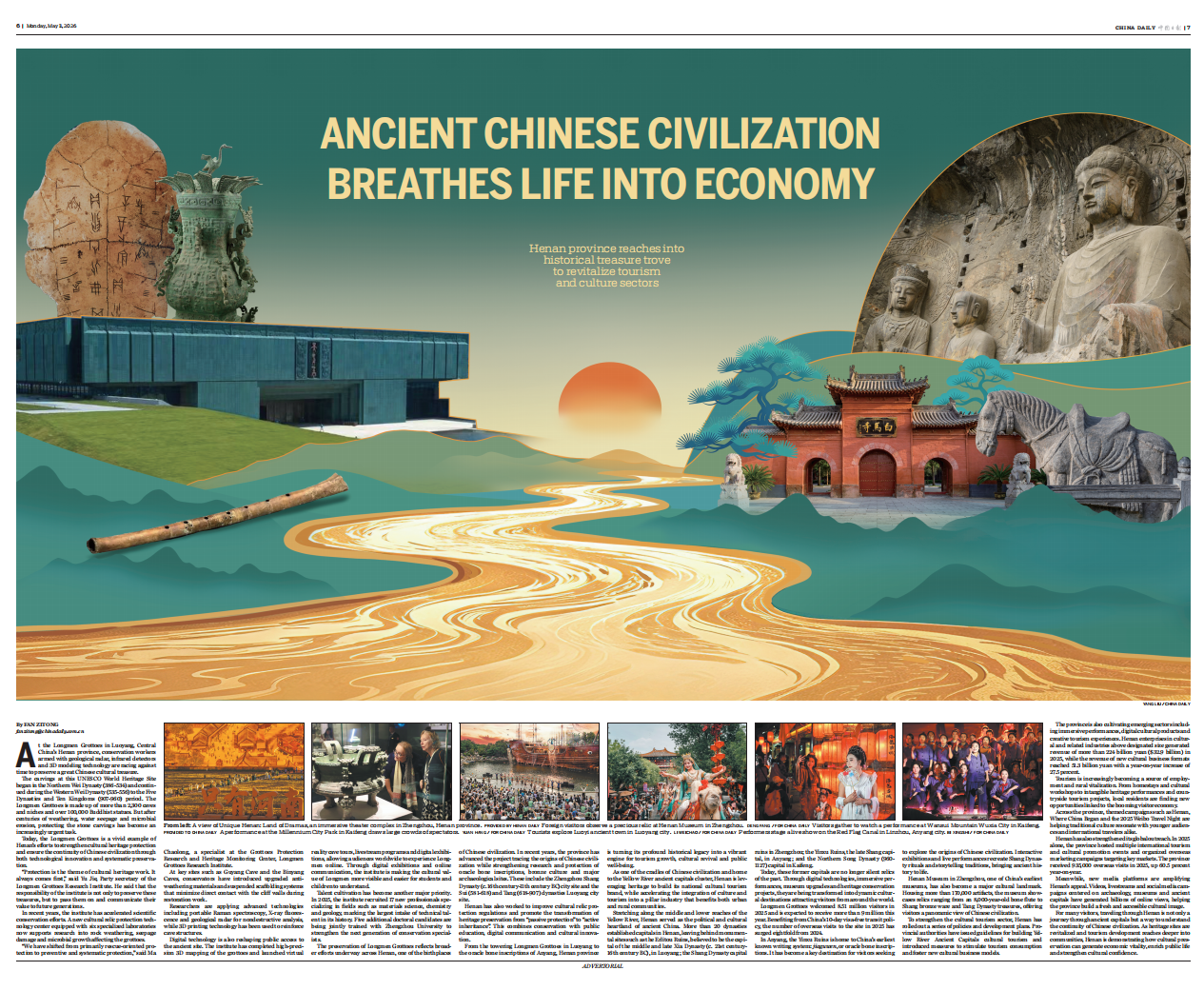
At the Longmen Grottoes in Luoyang, Central China's Henan province, conservation workers armed with geological radar, infrared detectors and 3D modeling technology are racing against time to preserve a great Chinese cultural treasure.
The carvings at this UNESCO World Heritage Site began in the Northern Wei Dynasty (386-534) and continued during the Western Wei Dynasty (535-556) to the Five Dynasties and Ten Kingdoms (907-960) period. The Longmen Grottoes is made up of more than 2,300 caves and niches and over 100,000 Buddhist statues. But after centuries of weathering, water seepage and microbial erosion, protecting the stone carvings has become an increasingly urgent task.
Today, the Longmen Grottoes is a vivid example of Henan's efforts to strengthen cultural heritage protection and ensure the continuity of Chinese civilization through both technological innovation and systematic preservation.
"Protection is the theme of cultural heritage work. It always comes first," said Yu Jie, Party secretary of the Longmen Grottoes Research Institute. He said that the responsibility of the institute is not only to preserve these treasures, but to pass them on and communicate their value to future generations.
In recent years, the institute has accelerated scientific conservation efforts. A new cultural relic protection technology center equipped with six specialized laboratories now supports research into rock weathering, seepage damage and microbial growth affecting the grottoes.
"We have shifted from primarily rescue-oriented protection to preventive and systematic protection," said Ma Chaolong, a specialist at the Grottoes Protection Research and Heritage Monitoring Center, Longmen Grottoes Research Institute.
At key sites such as Guyang Cave and the Binyang Caves, conservators have introduced upgraded antiweathering materials and suspended scaffolding systems that minimize direct contact with the cliff walls during restoration work.
Researchers are applying advanced technologies including portable Raman spectroscopy, X-ray fluorescence and geological radar for nondestructive analysis, while 3D printing technology has been used to reinforce cave structures.
Digital technology is also reshaping public access to the ancient site. The institute has completed high-precision 3D mapping of the grottoes and launched virtual reality cave tours, livestream programs and digital exhibitions, allowing audiences worldwide to experience Longmen online. Through digital exhibitions and online communication, the institute is making the cultural value of Longmen more visible and easier for students and children to understand.
Talent cultivation has become another major priority. In 2025, the institute recruited 17 new professionals specializing in fields such as materials science, chemistry and geology, marking the largest intake of technical talent in its history. Five additional doctoral candidates are being jointly trained with Zhengzhou University to strengthen the next generation of conservation specialists.
The preservation of Longmen Grottoes reflects broader efforts underway across Henan, one of the birthplaces of Chinese civilization. In recent years, the province has advanced the project tracing the origins of Chinese civilization while strengthening research and protection of oracle bone inscriptions, bronze culture and major archaeological sites. These include the Zhengzhou Shang Dynasty (c. 16th century-11th century BC) city site and the Sui (581-618) and Tang (618-907) dynasties Luoyang city site.
Henan has also worked to improve cultural relic protection regulations and promote the transformation of heritage preservation from "passive protection" to "active inheritance". This combines conservation with public education, digital communication and cultural innovation.
From the towering Longmen Grottoes in Luoyang to the oracle bone inscriptions of Anyang, Henan province is turning its profound historical legacy into a vibrant engine for tourism growth, cultural revival and public well-being.
As one of the cradles of Chinese civilization and home to the Yellow River ancient capitals cluster, Henan is leveraging heritage to build its national cultural tourism brand, while accelerating the integration of culture and tourism into a pillar industry that benefits both urban and rural communities.
Stretching along the middle and lower reaches of the Yellow River, Henan served as the political and cultural heartland of ancient China. More than 20 dynasties established capitals in Henan, leaving behind monumental sites such as the Erlitou Ruins, believed to be the capital of the middle and late Xia Dynasty (c. 21st century16th century BC), in Luoyang; the Shang Dynasty capital ruins in Zhengzhou; the Yinxu Ruins, the late Shang capital, in Anyang; and the Northern Song Dynasty (9601127) capital in Kaifeng.
Today, these former capitals are no longer silent relics of the past. Through digital technologies, immersive performances, museum upgrades and heritage conservation projects, they are being transformed into dynamic cultural destinations attracting visitors from around the world.
Longmen Grottoes welcomed 8.51 million visitors in 2025 and is expected to receive more than 9 million this year. Benefiting from China's 10-day visa-free transit policy, the number of overseas visits to the site in 2025 has surged eightfold from 2024.
In Anyang, the Yinxu Ruins is home to China's earliest known writing system: jiaguwen, or oracle bone inscriptions. It has become a key destination for visitors seeking to explore the origins of Chinese civilization. Interactive exhibitions and live performances recreate Shang Dynasty rituals and storytelling traditions, bringing ancient history to life.
Henan Museum in Zhengzhou, one of China's earliest museums, has also become a major cultural landmark. Housing more than 170,000 artifacts, the museum showcases relics ranging from an 8,000-year-old bone flute to Shang bronze ware and Tang Dynasty treasures, offering visitors a panoramic view of Chinese civilization.
To strengthen the cultural tourism sector, Henan has rolled out a series of policies and development plans. Provincial authorities have issued guidelines for building Yellow River Ancient Capitals cultural tourism and introduced measures to stimulate tourism consumption and foster new cultural business models.
The province is also cultivating emerging sectors including immersive performances, digital cultural products and creative tourism experiences. Henan enterprises in cultural and related industries above designated size generated revenue of more than 224 billion yuan ($32.9 billion) in 2025, while the revenue of new cultural business formats reached 51.3 billion yuan with a year-on-year increase of 27.5 percent.
Tourism is increasingly becoming a source of employment and rural vitalization. From homestays and cultural workshops to intangible heritage performances and countryside tourism projects, local residents are finding new opportunities linked to the booming visitor economy.
Across the province, themed campaigns such as Henan, Where China Began and the 2025 Weibo Travel Night are helping traditional culture resonate with younger audiences and international travelers alike.
Henan has also strengthened its global outreach. In 2025 alone, the province hosted multiple international tourism and cultural promotion events and organized overseas marketing campaigns targeting key markets. The province received 935,000 overseas visits in 2025, up 60.5 percent year-on-year.
Meanwhile, new media platforms are amplifying Henan's appeal. Videos, livestreams and social media campaigns centered on archaeology, museums and ancient capitals have generated billions of online views, helping the province build a fresh and accessible cultural image.
For many visitors, traveling through Henan is not only a journey through ancient capitals but a way to understand the continuity of Chinese civilization. As heritage sites are revitalized and tourism development reaches deeper into communities, Henan is demonstrating how cultural preservation can generate economic vitality, enrich public life and strengthen cultural confidence.
Editor:Zhou Jinmiao