
Home >>Culture
Unearthing life in the mists of time
Source:China Daily
Published:2026-05-20 15:12
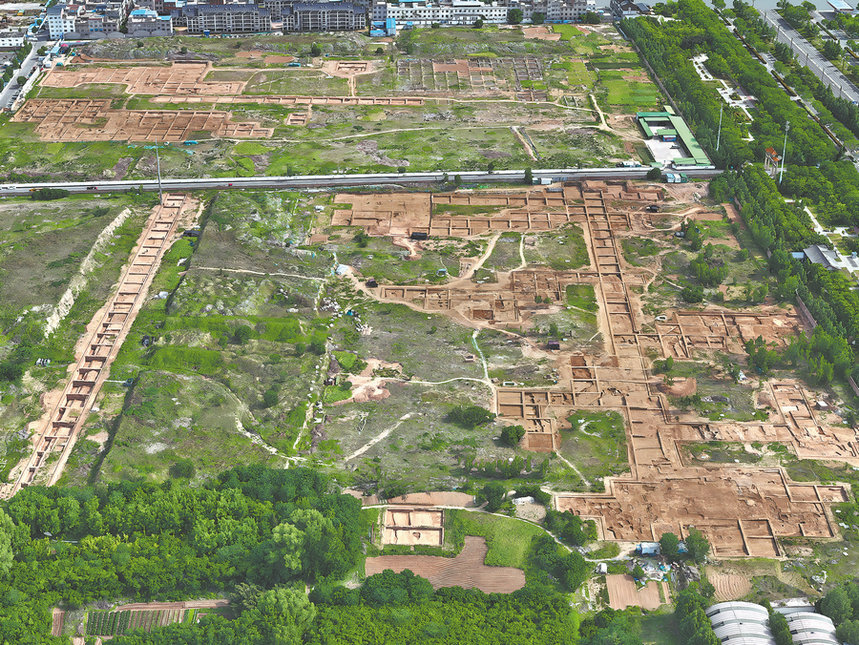
A bird's-eye view of the Zhengpingfang site in Luoyang, Henan province. [Photo provided to China Daily]
History books record emperors, wars and political systems. But how did people actually live? Where did they sleep, walk, and pray? The answers often lie not in texts, but beneath the soil in the silent ruins of ancient cities.
Now, for the first time, Chinese archaeologists have fully uncovered the layout of a fang (traditional Chinese residential unit) from the Sui (581-618) and Tang (618-907) dynasties in Luoyang, Henan province, which was the eastern capital of the two dynasties.
The era saw thelifangsystem implemented by the rulers as an urban planning mechanism that divided the capital city into walled residential wards called fang, with strictly controlled access via gates and curfews to reinforce social order and administrative management.
Zhengpingfang was one of the 103 residential units in the capital then, located near the central axis of the city, south of the Luohe River. As the fang had records of what it contained in the Tang era, but no existing aboveground architecture when archaeologists started excavation in 2020, it provided an excellent chance for them to carry out an archaeological project around this area.
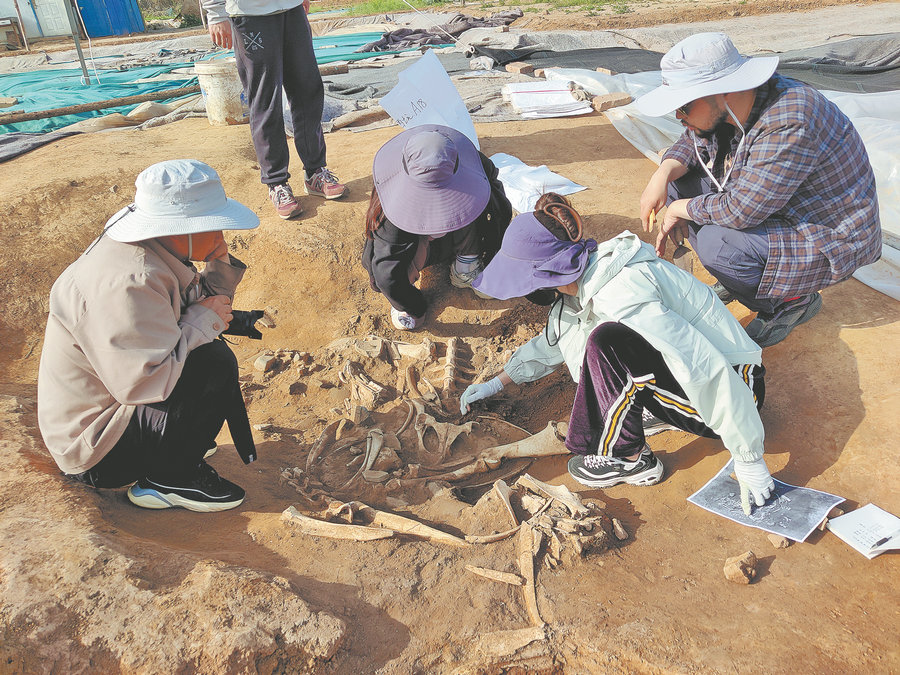
Technicians excavate a sacrificial pit containing animal bones at the site in 2023. [Photo provided to China Daily]
In the past six years, they have gained a panoramic view of the organization of the fang and the evolution of the architectural complexes within the area, thereby gaining a more thorough understanding of Sui and Tang governance, says Shi Zishe, head of the archaeological team at the site.
According to historical texts, a typical fang was square, with each side about one li (approximately 530 meters) long. Inside, east-west and north-south streets crossed like a chessboard, with walls on all four sides and a gate in the middle of each.
Zhengpingfang basically follows this layout, with its north-south side measuring 533.6 meters and its east-west side 464.6 meters. Archaeological investigations show that the inner road network changed over time, from a cross shape to a T-shape, with nearly half of the east-west road occupied by a large complex that covered the entire western half of the fang area in its later years.
Archaeologists also found that the complex's northern wall broke through the ward's original northern boundary, extending about two meters into a road. This was strictly forbidden in the early and middle Sui-Tang periods.
So who was powerful enough to break the rules? By consulting historical records, archaeologists believe it was a residential complex of Princess Taiping, the beloved daughter of Tang emperor Li Zhi and empress Wu Zetian.
"Although we haven't yet found direct evidence such as inscriptions, the layout of the complex, its specifications and the unearthed artifacts all match historical descriptions," says Shi. "Therefore, we believe it was the princess' residence as recorded."
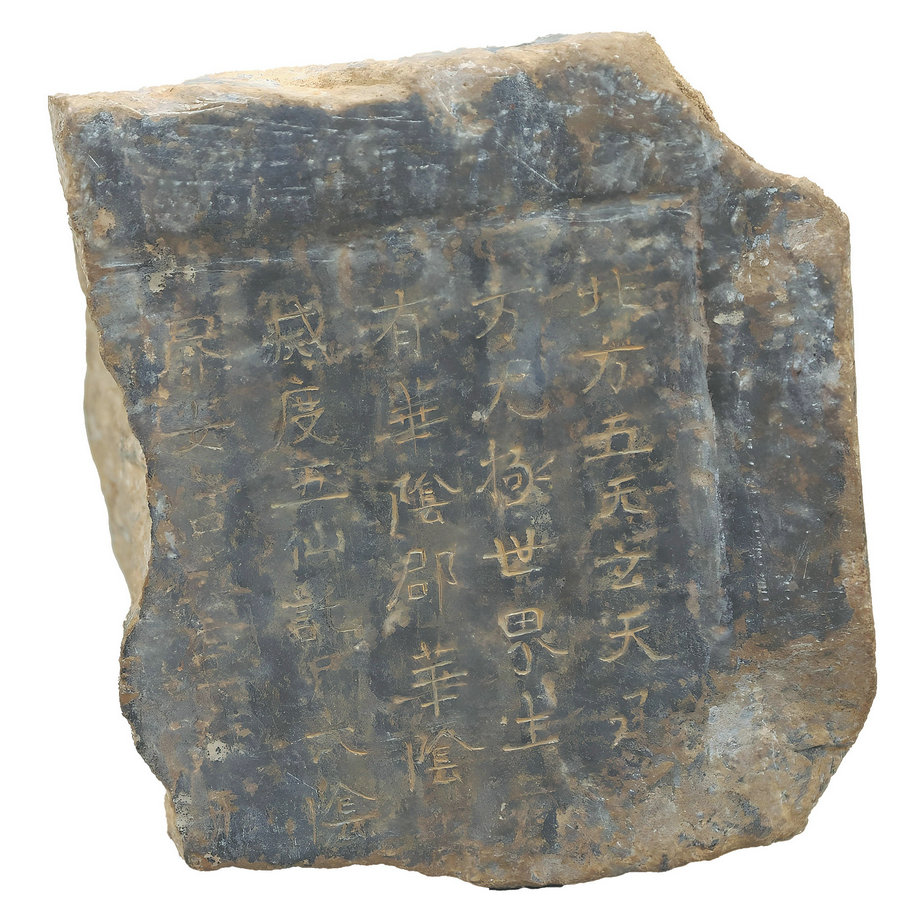
Part of a five-directional tombguarding stone and an eave tile found at the site. [Photo provided to China Daily]
Princess Taiping was the only daughter of the imperial couple who grew to adulthood. Just like her mother, she was ambitious and deeply involved in political struggles. For a time, she was one of the most powerful figures in the Tang court, although she would eventually lose a political struggle to her nephew, Li Longji.
The princess had gifted the complex to her elder brother Li Dan, who later changed the fang into a Taoist abbey named Anguo Temple after he ascended the throne. Under the reign of Emperor Li Longji, it was changed into a Taoist abbey for female priests, including Princess Yuzhen, a sister of Li Longji.
Shi says they have found that the Taoist temple as a whole features a multi-courtyard layout consisting of three parallel east-west parts. The central part is an axial courtyard centered around a large square hall, with well-proportioned buildings arranged in an orderly manner.
The southern part of the complex was a garden, in which there was a lake with three artificial hills.
"Since the Wei (220-265), Jin (265-420), and Southern and Northern Dynasties (420-581), people often created a garden in their residence. It became a popular tradition," says Zheng Guoqi, another team member from the Luoyang City Cultural Relics and Archaeology Research Institute.
The lake and three hills were not just decorative. Instead, they carried deep Taoist symbolism. The lake represented the East Sea, home to the immortals. The three hills stood as Penglai, Fangzhang and Yingzhou — the three mythical mountains where celestial beings are said to live. This tradition, which began in theHan Dynasty(206 BC-AD 220), was often followed by the royal family to express their desire for immortality.
"This excavation has, for the first time, revealed the complete layout of an ancient garden built following this idea," Shi says.
In the southeastern part of the site, archaeologists found special architectural foundations believed to be Guozijian (the Imperial College) and aConfuciustemple. The northeastern part yielded well-organized courtyards, probably residences of officials, based on records.
"Altogether we have found remains of over 100 rammed earth buildings from the area and many daily necessities like ceramic and pottery vessels, suggesting the fang was once a populated place," says Zheng.
"It's a rare chance for us to excavate a fang from the Sui and Tang periods," says Shi. "Zhengpingfang boasts a rich array of buildings, from the government's ritual and religious complexes to residences of civil and military officials. With that diversity, it's a representative example of the many fang units that once made up the city."
He says that, in the past, they have excavated some parts of other wards, like the Longxing Temple in Ningrenfang and the old residence of Tang poetBai Juyiin Lyudaofang, but they have never unveiled another fang as complete as this one.
"The ancient fang units were like modern subdistricts," says Shi. "No two were the same. Back then, each fang was unique, just like the subdistricts we see today."
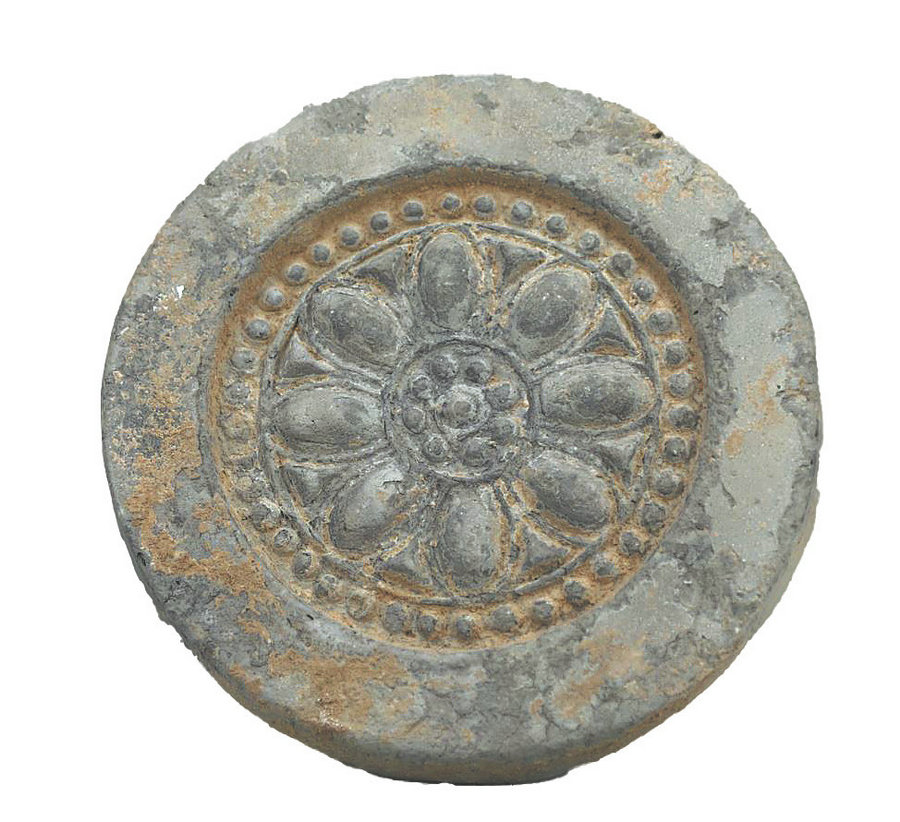
Part of a five-directional tombguarding stone and an eave tile found at the site.[Photo provided to China Daily]
From 605, when Emperor Yang of the Sui Dynasty ordered the construction of Luoyang as the Sui's eastern capital, Luoyang became an important city for the Sui and the subsequent Tang Dynasty.
The city further flourished under the rule of Empress Wu, who wanted to defy the tradition that only men could rule. She therefore distanced herself from the Tang royal family, which was based in Chang'an (present-day Xi'an, Shaanxi province), to establish a new political order. She chose Luoyang as her capital city and called it the "divine capital".
The archaeological dig at Zhengpingfang is another highlight of the studies carried out on Luoyang during the Sui and Tang periods, which archaeologists have worked on for decades.
Shi says their earlier efforts have basically provided knowledge about the layout and evolution of the ancient city, as archaeological work has previously been carried out on the ruins of the palace complex, one of Sui's largest granaries called Hanjia and thelifangareas to the south and north of the Luohe River.
Shi says the team will continue excavating the northeastern part of the fang to learn more. They also plan further work at Lyudaofang, a ward with no official buildings, but one whereBai Juyi's poems vividly capture the dynamism of everyday life.
"With the refined tastes of literati and the vibrant realities of everyday life, we believe that Lyudaofang is also well worth archaeological efforts," says Shi.
Editor:Zhou Jinmiao