
Home >>Culture
Russian master follows tai chi to ancient roots
Source:China Daily
Published:2026-06-02 11:30
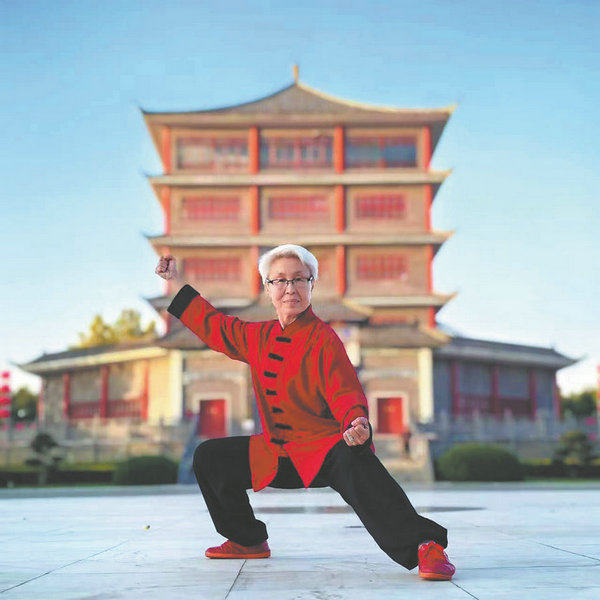
Kobiakova strikes a traditional tai chi pose in front of the Chinese Tai Chi Museum in Chenjiagou village, Henan province, in October 2025. [Photo provided to China Daily]
In the pale light of dawn, a solitary figure stands in a courtyard in Chenjiagou village of Wenxian county, Henan province. With her legs bent and arms encircling the air, Svetlana Kobiakova, 59, from Russia's Yakutsk, holds azhanzhuang(standing meditation) posture.
Several minutes later, she flows into the Chen-styletaijiquan (tai chiboxing) routine. Her movements are silk-smooth, her breath deep.
Kobiakova, a disciple of Chenstyle tai chi, has immersed herself in tai chi practice for 15 years. She now serves as a master at Chenjiagou Taijiquan School.
At a glance, you might mistake her for a local. Known by her Chinese name, Chen Yimei, Kobiakova belongs to the Sakha (Yakut) ethnic group of Russia, a people with ancient Siberian roots who share striking physical similarities with East Asians.
Over the years, she has visited Chenjiagou, the birthplace of Chenstyle tai chi, 13 times. Last September, she started her longest journey, a full year of immersion in the village that has become her spiritual home.
"The philosophy, technique, and internal energy of tai chi have endless layers waiting for me to explore," she says.
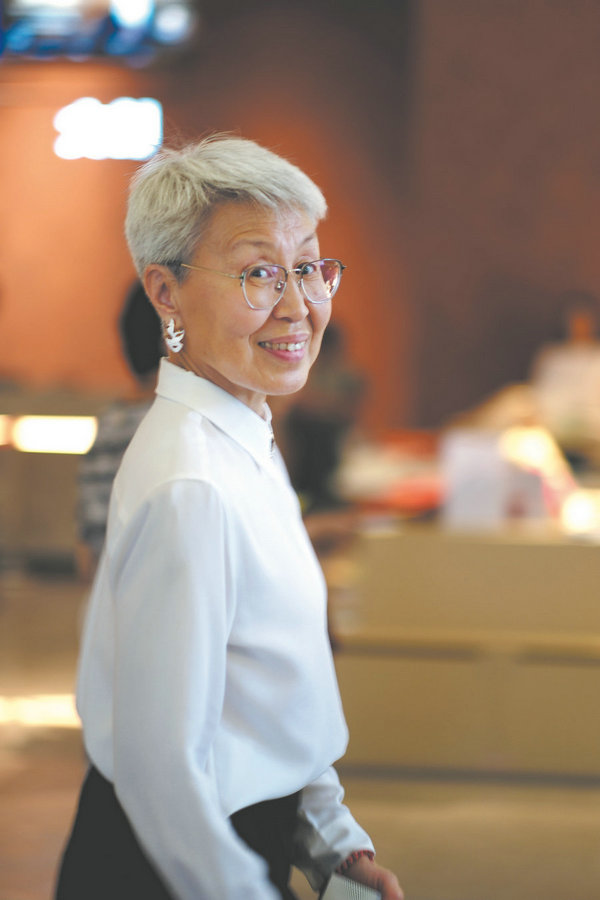
Svetlana Kobiakova at Chengdu Grand Theatre to watch an opera in May. [Photo provided to China Daily]
Before tai chi, her life was a model of rationality. She worked as a physics teacher, a researcher at an institute, and a specialist studying the physical properties of diamonds. Her world was governed by data and logic.
She had tried other martial arts, such as karate and taekwondo, but none touched her heart.
Her introduction to tai chi came when she accidentally witnessed someone practicing the art, and she then learned the basics from a practitioner in Russia. However, she soon found herself unable to make progress.
"I reached a clear conclusion, to learn real tai chi, you must go to its root," she says.
So, she emailed the Chenjiagou Taijiquan School and received a warm invitation. Arriving there in 2011, she found something unexpected.
"I felt an unexplainable sensation of peace and joy," she says softly. "Tai chi gets deeper the more you learn. It's like climbing endless mountains. Every time you reach one peak, you see a higher one ahead. There is never an end to progress — and that is its greatest charm.
"I used to suffer from bronchitis. Practicing tai chi has helped me feel more balanced and relaxed physically," she says.
"I think tai chi also reshaped my temperament, making me calm, positive, and peaceful."
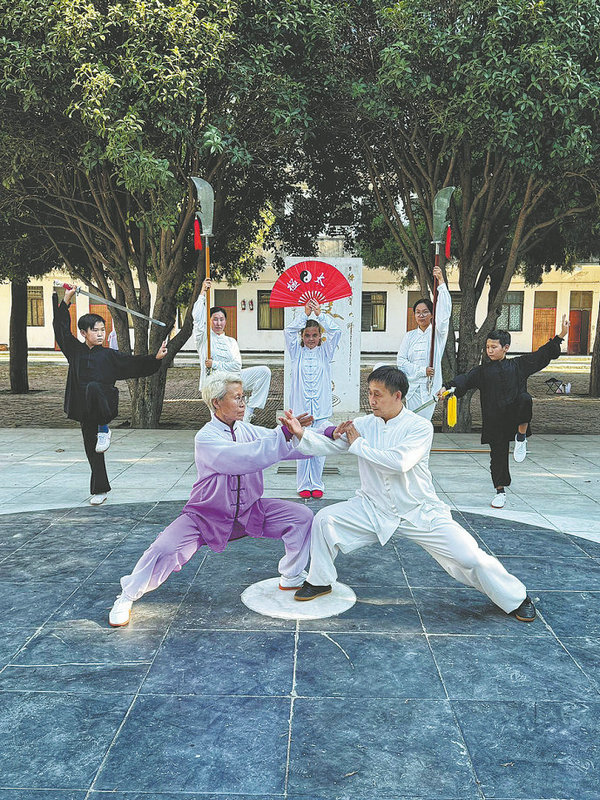
Svetlana Kobiakova practices tai chi with Chen Ziqiang, her master at the Chenjiagou Taijiquan School, in August 2024. [Photo provided to China Daily]
Chen Ziqiang, her master, head coach at the Chenjiagou Taijiquan School and a 20th-generation descendant of the Chen family, praises her dedication.
"She is diligent and hardworking, practicing and deepening her understanding of tai chi culture," he says.
"Tai chi is a vivid and concrete embodiment of traditional Chinese culture. While much of traditional Chinese heritage is abstract and profound, tai chi is observable and learnable, offering and showing the wisdom and philosophies of Chinese culture."
From 2012 to 2015, Kobiakova achieved outstanding results in major international tai chi competitions worldwide. She was the European champion five times and a silver medalist at the 1st World Taijiquan Championship held in Chengdu, Sichuan province, in 2014.
Furthermore, she serves as a certified referee for the Russian WushuFederation.
Having taught both Chinese and Western students, Kobiakova offers unique insights into cross-cultural learning. She has resigned from her research career entirely and founded her own tai chi school in Russia.
Now, Kobiakova is the first foreign master to teach tai chi at Chenjiagou Taijiquan School.
"My students range from 6-year-old children to 80-year-old elders," she says, adding that nationalities approach the discipline differently.
"European learners are usually more relaxed in the beginning," she says, but once foreign learners truly immerse themselves in tai chi's inner logic and philosophy, they become equally devoted and persistent.

She practices tai chi fan in Yakutsk, the Republic of Sakha, Russia, in 2018. [Photo provided to China Daily]
"Deep down, all people are the same," she insists. "Everyone who loves tai chi is seeking inner peace, balance, and self-improvement."
She draws a contrast between tai chi and entertainment such as music or other sports.
"Music comforts the soul, but tai chi heals the body and cultivates the spirit at the same time. It is a lifestyle, a philosophy, and a treasure that deserves to be shared worldwide."
Kobiakova devotes about eight hours a day to tai chi. "Evening training has a different quality," she explains.
"The busy day quiets down. The body has been awake and moving, and the mind is finally ready to absorb."
Dai Ruijun, 43, a Chinese student from Xinyang city, Henan province, followed her 15-year-old son to Chenjiagou four years ago.
She recalls noticing Kobiakova early on. "Her tai chi skills are exquisite, and she treats everyone with warmth and kindness," she says.
Dai's son is taught by Kobiakova."She even uses English to teach him the moves, correcting his postures while helping him build a language foundation," Dai notes.
"My son has become calmer, more focused, and more resilient. Tai chi is wonderful for teenagers," she adds.
Kobiakova plans to continue promoting traditional Chen-style tai chi when she returns to Russia, aiming to introduce more people abroad to Chinese culture.
"Tai chi gave me a new life," she says. "I hope I can spend my whole life passing this treasure on to the world."
Editor:Zhou Jinmiao