
Home >>Culture
Buried mine rewrites the past
Source:China Daily
Published:2026-06-16 10:05
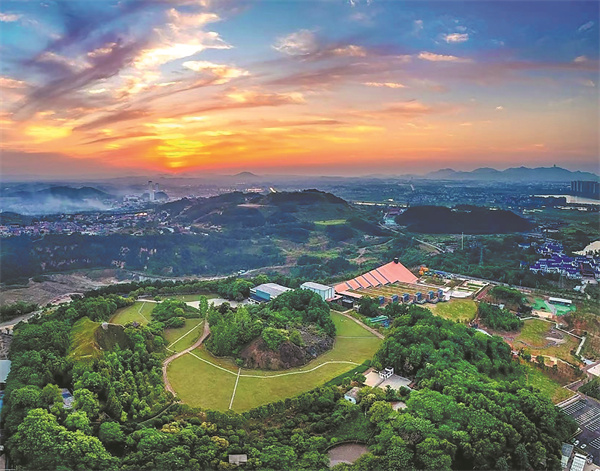
An aerial view of the Tonglushan Ancient Copper Mine site. DENG ZHANGYU/SUN MENG/CHINA DAILY
In 1928, archaeologists unearthed a vast collection of bronze artifacts dating back about 3,300 years at the Yinxu Ruins in Anyang, Henan province, including a massive bronze vessel weighing 832.84 kilograms. The discovery raised a fundamental question: Who produced such a large quantity of bronze, and where did the copper originate? Despite decades of research, no definitive answers emerged, prompting some scholars to speculate that China's bronze culture may have had foreign origins.
A breakthrough finally came in 1973. At a mining site in Daye, Hubei province, archaeologists discovered copper axes, the largest weighing 16.3 kg, revealing an ancient mine that had been buried for more than 2,000 years. The site is now known as the Tonglushan Ancient Copper Mine.
Years of archaeological investigation suggest that mining at the Tonglushan site was most active from the Shang Dynasty (c. 16th century-11th century BC) to the Western Han Dynasty (206 BC-AD 24), spanning over 1,000 years.
"This discovery finally provided the long-sought answer to the source of raw materials for bronze artifacts, rewriting the history of China's ancient bronze civilization," says Wu Hongtang, a veteran archaeologist who participated in the site's first excavations in the 1970s.
According to Wu, Tonglushan is an ancient mining and smelting complex distinguished by its long period of operation, large scale, complete production chain, advanced technology, and exceptional state of preservation.
To date, archaeologists have identified more than 100 mining and smelting sites and over 250 ancient tombs, along with a wealth of mining tools and traces of daily life.
Wu notes that among the many ancient copper mining sites discovered in China, Tonglushan is the only one where miners' tombs have been found.
Fewer than 300 artifacts have been unearthed from these tombs. Among them are two high-status burials, believed to belong to a mining engineer and a site supervisor, containing valuable objects such as copper knives, jade artifacts, and small bronze cauldrons.
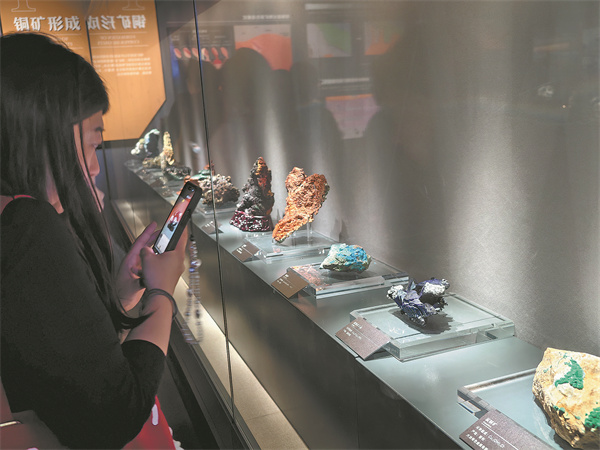
Different types of copper ore are on show at the Tonglushan Site Museum. DENG ZHANGYU/SUN MENG/CHINA DAILY
"The limited number of unearthed artifacts suggests that the living conditions for ordinary miners at the time were extremely harsh. The differences among the tombs also reflect the class distinctions of that era," Wu explains.
One of the site's most remarkable discoveries is a set of 35 barefoot footprints left by ancient miners. In 2012, Chen Shuxiang, a researcher at the Hubei Provincial Institute of Cultural Relics and Archaeology, and his colleagues uncovered the footprints during an excavation.
The prints vary in condition, with the longest intact footprint measuring 26 centimeters. Based on their characteristics, experts identified them as ancient barefoot impressions. Judging from their depth and surrounding evidence, Chen says he believes the miners were likely carrying heavy loads while crossing wet ground.
Chen notes that some mining shafts reach depths of 60 to 80 meters. Yet, no human remains have been found inside them, suggesting that no major underground accidents occurred during the site's long history of operation.
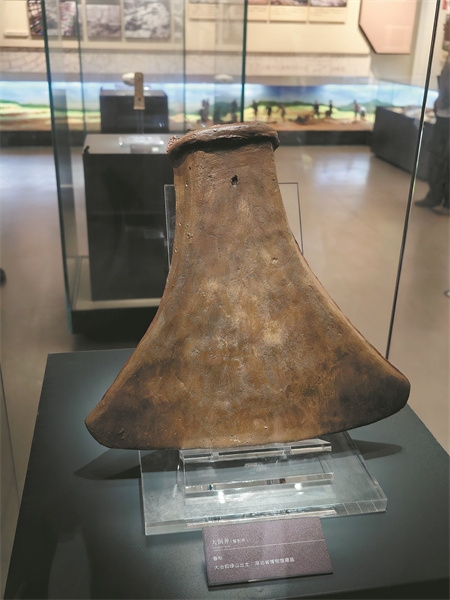
A bronze ax (left) dated about 2,000 years ago and a bronze battle-ax from the Western Zhou Dynasty (c. 11th century-771 BC). DENG ZHANGYU/SUN MENG/CHINA DAILY
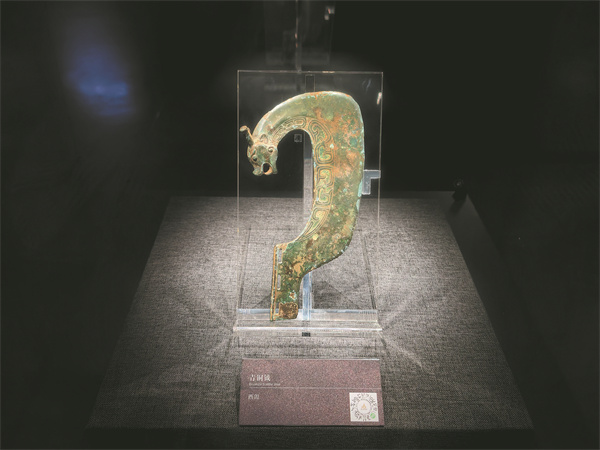
A bronze ax (left) dated about 2,000 years ago and a bronze battle-ax from the Western Zhou Dynasty (c. 11th century-771 BC). DENG ZHANGYU/SUN MENG/CHINA DAILY
At the Tonglushan Site Museum, visitors can view a vast archaeological excavation resembling an "underground labyrinth". The original mining site, a dense network of shafts and tunnels, has been preserved in situ beneath a protective exhibition hall measuring 36 meters long and 30 meters wide, built in 1984.
Viewed from above, visitors see a "maze" of vertical shafts, inclined passageways, horizontal tunnels, and blind shafts supported by wooden structures.
Drainage channels and wooden troughs weave through the complex, offering a vivid picture of how ancient miners excavated ore and maintained underground operations.
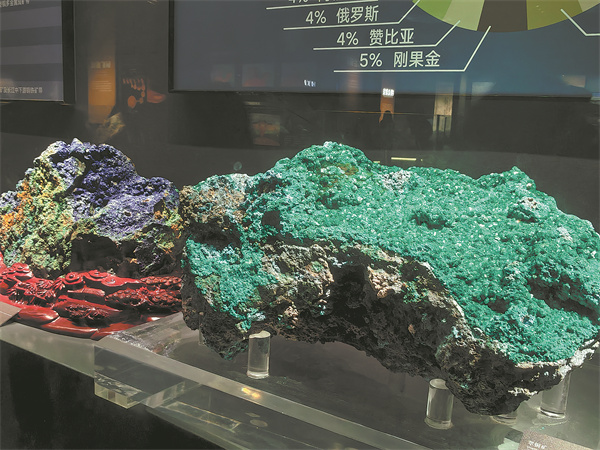
Malachite unearthed from the Tonglushan site was used by ancient miners to locate copper deposits. DENG ZHANGYU/SUN MENG/CHINA DAILY
The museum's new building, opened in June 2023, features five themed exhibition halls that explore how ancient people located copper deposits, developed mining techniques, mastered smelting technology, and transported bronze materials across the region.
Wu says that in ancient times, people often located copper deposits by looking for a plant called Elsholtzia splendens, which has red stems and green leaves. It resembles a toothbrush and produces purple flowers.
Every November, when the flowers are in full bloom, Tonglushan Mountain is covered in a sea of purple.
The site's copper-smelting technology was remarkably advanced. Ancient metallurgists developed a stone-built shaft furnace into which alternating layers of ore and charcoal were loaded. Unlike contemporary furnaces in Mesopotamia, which were typically used only once, these furnaces could be reused repeatedly.
It is estimated that the mining area produced about 400,000 metric tons of ancient slag, yielding between 80,000 and 120,000 tons of crude copper. The copper ingots smelted had a copper content of over 93 percent, while the slag contained only 0.7 percent copper — evidence of highly efficient purification techniques.
"This level is remarkably close to modern standards," Wu says.
Scientific testing has since confirmed that the elemental composition of copper used in bronze artifacts from the Panlongcheng site in Wuhan, Hubei province, and the bronzes found in Fu Hao's tomb at Yinxu matches that of copper from Tonglushan.
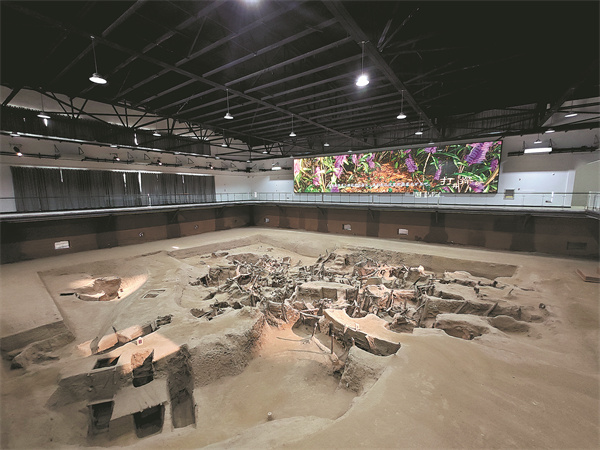
An archaeological site at the Tonglushan Site Museum shows an "underground labyrinth" of crisscrossing shafts and tunnels. DENG ZHANGYU/SUN MENG/CHINA DAILY
The findings provide strong evidence that Tonglushan served as a major source of copper for China's bronze industry in ancient times,"proving that China's bronze civilization developed independently and formed its own system", Wu says.
Daye, where the Tonglushan site is located, is adjacent to the Yangtze River. At that time, the transportation route likely involved moving goods via the Yangtze River to an ancient dock in Nanyang, Henan, and finally reaching the ancient capital Luoyang, then a major political and cultural center.
"The abundant copper resources in the middle reaches of the Yangtze River, combined with bronze smelting and casting technologies that spread southward from the Central Plains dynasties in northern China, together created the bronze civilization of the Yangtze River basin," says Zhang Changping, a history professor from Wuhan University.
Editor:Zhou Jinmiao