
Home >>Focus
Micro-dramas reshape China's film economy
Source:China Daily
Published:2026-06-22 09:46
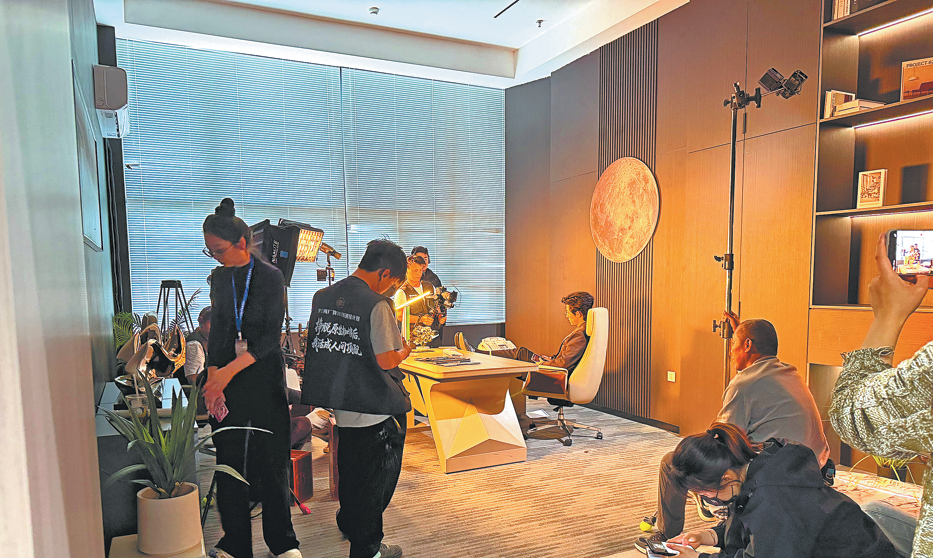
A micro-drama is filmed at a production hub in Guangfeng district, Shangrao, Jiangxi province. [Photo provided to CHINA DAILY]
China's micro-drama industry has transitioned from a localized internet trend into a massive, industrialized economic driver, pulling in millions of yuan in regional investments while facing immediate disruption from generative artificial intelligence.
Driven by extreme turnaround times, regional manufacturing centers are rapidly converting idle infrastructure into high-capacity production hubs such as Jiangxi province's Guangfeng district, which alone generated an output value exceeding 500 million yuan ($74 million) in 2025 by transforming old factories into specialized, rapid-fire filming bases.
Pang Daoming needed five days, 600,000 yuan and dozens of background actors to finish a micro-drama set in China's Republican era in Shangrao, Jiangxi province.
The Shanghai-based producer had come to the micro-drama production hub in Guangfeng, where a former factory has been turned into rows of period streets, modern offices, hospital wards, villas, village houses and European-style sets.
Production hub
The production hub was converted from the former Guangfeng Cigarette Factory. The site covers more than 8 hectares and has over 360 filming scenes. It is designed to host up to 40 crews and more than 2,000 cast and crew members working at the same time.
For a business built on speed, the calculation was simple. The scenes were ready. Background actors could be found quickly. Different crews could shoot in different corners of the hub at the same time.
"The base has newly built scenes from the 1970s and 1980s, which fit the period drama we are shooting," Pang said.
His crew planned to finish the current production in five days, before moving on to another one that would take about six days.
Pang entered the micro-drama business in July 2023. His company has produced about 70 to 80 micro-dramas. A crew like his may need dozens of background actors a day, with daily pay generally ranging from 100 to 300 yuan.
One of the people who entered the industry through such jobs is Zhou Tao.
Before the micro-drama crews arrived, Zhou, 38, ran a small shop near the production hub. He had spare time, and as more crews came to Guangfeng, he decided to try working as a background actor.
His first role was a villager in a period drama. The job lasted three days.
"It felt new," Zhou said. "I never thought there would be a day when I would become an actor."
At first, he was nervous. By his fourth production, he had been given a role with lines. When he faced the camera, his mind went blank. But the shoot went smoothly, and the experience pulled him further into the work.
By the end of March 2025, Zhou had become a background actors coordinator, helping crews match background actors with different scenes. By July, he had put himself fully into the business. He tried different roles, auditioned for speaking parts, and began watching other micro-dramas and television series to study how people acted.
"I was never this hardworking when I was at school," he said.
At his busiest, Zhou said he spent more than 20 days a month on set, sometimes as many as 25. His monthly income could reach 8,000 to more than 10,000 yuan.
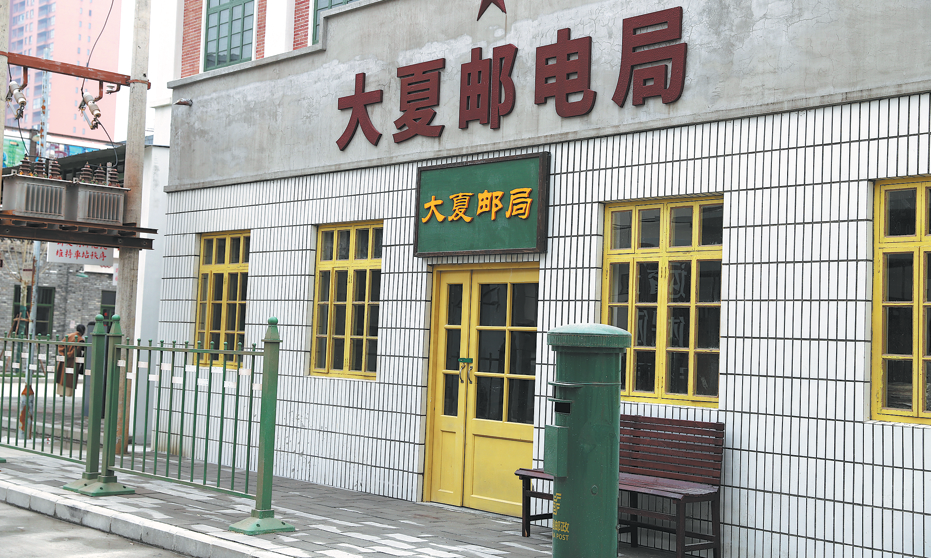
The production hub, which used to be the Guangfeng Cigarette Factory, features more than 360 filming scenes, such as a post office. [Photo provided to CHINA DAILY]
For some younger locals, the work is less stable but still attractive.
Ding Junyan, born in 2007 in Shangrao, joined the local actors' association after graduating from high school. She first saw the opportunity on a recruitment app.
"I wanted to be an actress when I was a child," Ding said. "Even though I only appear in micro-dramas for a few minutes, I am still happy."
She now works about 10 days a month on average and earns about 5,000 to 6,000 yuan.
Rao Wenhua, head of the Guangfeng Actors Association, said the association has more than 1,000 registered actors, over 80 percent of them from Shangrao. Ordinary background actors usually earn 100 to 300 yuan a day, while those with lines or specific performance requirements can earn at least 300 yuan, and sometimes up to 1,000 yuan per day.
The association helps organize actors, connect them with crews, provide free training and offer support in labor disputes, Rao said.
Impact of AI
What is happening in Guangfeng is one version of a wider industry shift.
At Hengdian World Studios in Dongyang, Zhejiang province, the rise of vertical-screen dramas has added a new layer to an established film industry. Hengdian received more than 2,300 vertical micro-drama crews in the first seven months of 2025, surpassing the total for the whole of 2024, according to data cited by Securities Times.
The pressure on space has changed how the film town is used. A service company official told the newspaper that micro-drama crews could be seen shooting outside his office window every day. Even an office building with a glass facade had been used repeatedly as a stand-in for airport and railway station scenes.
An actor identified by the newspaper as Chen Lin said schedules could be packed closely together. Sometimes, he said, he would finish one production one day and enter a new crew the next.
In Hangzhou's Linping district, the model looks different. There, the Linying Factory, a professional micro-drama production base, has more than 50 indoor filming scenes, along with dormitories, canteens, costume and makeup services and an actors' guild. The district has also linked the factory with old streets, ancient towns and other local locations to form a wider filming network.
The pattern is similar in different places: a short production cycle requires concentrated scenes, fast coordination and a local labor pool that can be called in quickly. For crews, the question is no longer only where a story should be set, but where it can be completed at the required speed and cost.
But the same industry that brought crews and actors into these bases is changing quickly.
Zhou said he has already felt the impact of AI this year.
"AI has indeed brought an impact to micro-dramas," he said. "It has shortened the production cycle and greatly reduced costs. The income of background actors has also been affected, and some people are getting fewer jobs."
Still, he does not think live performers will disappear.
"On the other hand, it is also pushing micro-dramas toward higher quality," he said. "Some platforms are also checking the AI content in dramas. I don't think AI performance can replace real people for now."
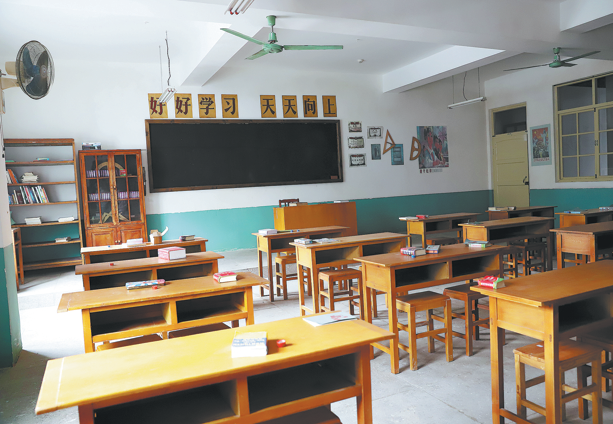
A classroom set at micro-drama production hub in Guangfeng district, Shangrao, Jiangxi province. [Photo provided to CHINA DAILY]
Fang Liqi, a producer at Damahou, a micro-drama production company shooting in Shangrao, sees the shift from the company side.
Fang's company moved into the Guangfeng hub at the end of February 2025 after spending about a year shooting in Yingtan, another city in Jiangxi. Before settling in Shangrao, the company had inspected locations across the country and chose Guangfeng for its scenes, policy support and overall production conditions.
The company produced more than 120 micro-dramas in Shangrao in 2025 and plans to produce about 200 this year. It is now also developing AI-generated micro-dramas.
Fang said an AI-produced costume drama may cost 200,000 to 300,000 yuan, while a live-action modern drama may cost 300,000 to 400,000 yuan. An AI version of a modern drama could cost just over 100,000 yuan, he said.
The debate is no longer only whether AI can make a drama. It is what kind of people and jobs will still be needed when parts of the process become cheaper and faster.
Wei Qintao, who is in charge of quality of micro-dramas at Hongguo, told People's Daily that the market had "over-worried or over-interpreted" the impact of AI micro-dramas on live-action productions.
"Live-action dramas are still our basic market," Wei said, adding that he did not believe they had reached the end of their growth or entered decline.
At the same time, Wei noted that mid-level actors, costume and makeup workers, lighting technicians and camera operators face uncertainty as AI changes the sector.
Shen Yang, a professor at Tsinghua University's School of Journalism and Communication, said that in the AI era, human value lies partly in the answers found by asking the right questions.
"What matters most is aesthetics and taste," Shen said.
Overseas market
For production companies, the pressure is also coming from platform policies.
Fang said that before this year, some platforms offered guaranteed payments of 300,000 to 500,000 yuan or more for approved projects. Some companies secured projects and then subcontracted production to others at lower prices. That could bring more projects into the market, but quality was often uneven. Many companies that relied on that model closed earlier this year, he said.
"We make live-action dramas, and we also make AI dramas," Fang said."This market is still worth doing. In the future, content will still be king. As long as the content is good, whatever the form, audiences will pay for it."
For Pang, the next question is not only how to produce faster in China, but where the audience will come from.
His company has launched an overseas app carrying Chinese micro-dramas translated into Southeast Asian languages. The platform has more than 100,000 paying members, he said.
The overseas market is growing quickly. App data analysis firm Sensor Tower said global in-app purchase revenue for short-drama apps approached $700 million in the first quarter of 2025, nearly four times the level of a year earlier. Southeast Asia was one of the fast-growing markets, with downloads in the region rising 61 percent quarter-on-quarter to nearly 87 million in the same period.
For Pang's company, the next plan is to shoot locally in countries such as Indonesia and Thailand, using local actors and stories closer to local audiences.
"At the beginning, we put Chinese micro-dramas overseas after translating them into Southeast Asian languages," Pang said. "But later we still want to go there, shoot locally, use local actors and make stories that local audiences like."
Editor:Zhou Jinmiao