
Home >>National
MegaRobo tech boost for scientific research
Source:China Daily
Published:2026-07-25 21:57
Developing a new medicine can take a decade, cost 1 billion yuan ($147.6 million) and still has less than a 10 percent chance of success — a widely-known industry equation that Chinese AI-tech company MegaRobo Technologies said artificial intelligence could help rewrite.
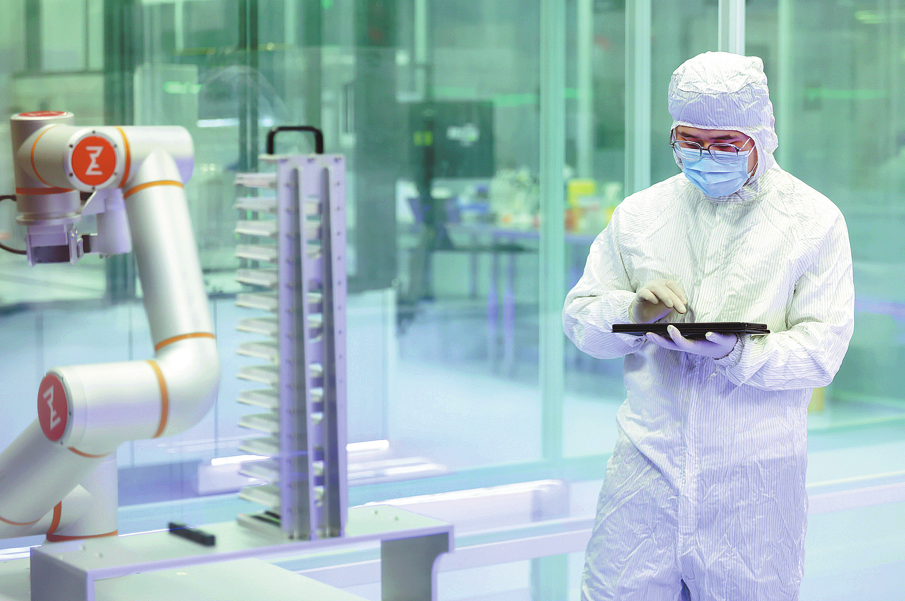
At its Megalaxy Laboratory in Suzhou, Jiangsu province, clusters of AI agents direct robotic arms, incubators and liquid-handling workstations through experiments around the clock, linking computer-generated designs with physical testing and using each result to decide what to try next.
MegaRobo said a team of eight scientists and technicians used the system to complete 56 rounds of antibody experiments in four months, raising the accuracy of predictions for stability, expression, toxicity and binding affinity to about 90 percent from 70 percent.
MegaRobo Founder and CEO Huang Yuqing said the system shows how autonomous AI agents can lower research costs and shorten the path from laboratory discovery to market.
"Comparable work using conventional methods would typically require 40 to 50 people and take three to four years. We believe the entire new drug development process could eventually be completed within five years," he said.
MegaRobo's ambitions extend beyond drug discovery. At one large pharmaceutical manufacturer, production yield had remained at about 80 percent of its theoretical maximum, despite already ranking among the industry's best, Huang said.
MegaRobo combined real-time sensor readings with historical production data and used AI models to identify factors that had been overlooked by human operators, according to the company.
The manufacturer subsequently lifted its yield to 95 percent, cutting annual raw material costs by more than 20 million yuan. Automation also allowed one work team to oversee four production lines instead of one, MegaRobo said.
The cases show how AI is moving beyond chatbots and content generation into the physical economy, where autonomous systems can operate machinery, conduct experiments and adjust industrial processes in real time.
Inside MegaRobo's Suzhou laboratory, there are few researchers carrying test tubes or manually recording data. Instead, robotic arms move samples between automated incubators, testing equipment and liquid-handling stations.
The system can perform tasks including nucleic-acid extraction and cell cultivation with little human intervention. MegaRobo said some processes could be executed more than 20 times faster than conventional manual work, while operating continuously.
"Our original idea was very simple: use robots to free scientists' hands and AI to equip their minds," Huang said.
The company soon found that researchers did not want a single machine. They wanted a complete system that could understand research objectives, coordinate different instruments and learn from the results.
"We quickly hit a wall," Huang said. "Scientists did not need one robot. They needed an entire solution."
MegaRobo has since developed autonomous-agent and multiagent systems for intelligent laboratories and advanced manufacturing.
Its technology is built around a closed loop of perception, reasoning and execution, allowing AI agents to analyze their surroundings, formulate plans and control physical equipment.
The company said it has served more than 1,000 research institutions, hospitals, universities, pharmaceutical companies and advanced manufacturers worldwide.
"The goal is not simply to make experiments faster," Huang said. "It is to change how scientific research is done."
Editor:Zhou Jinmiao