
Home >>Focus
Forging shields with code
Source:China Daily
Published:2026-07-31 09:49
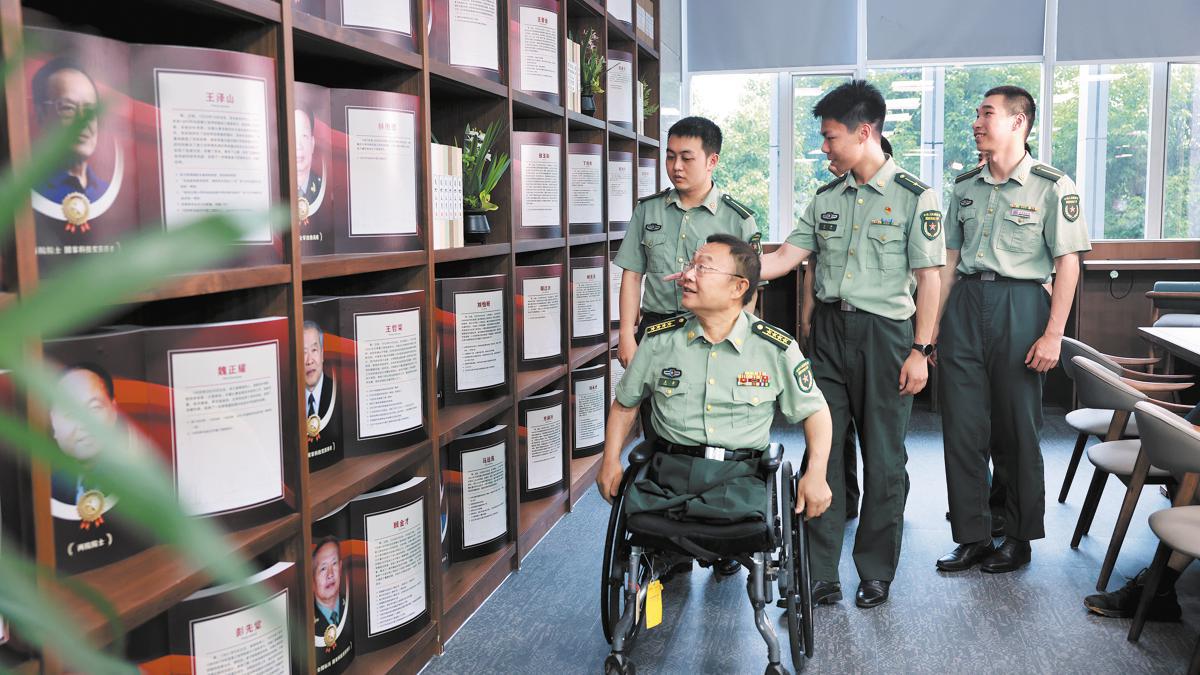
Wang Ji (front) talks with his students about renowned scientists at the library of the National University of Defense Technology in Changsha, Hunan province, in May. ZHOU FUJING/FOR CHINA DAILY
Around 7 am, as he does every morning, Wang Ji wheeled himself into his office at the College of Computer Science and Technology of the National University of Defense Technology. For more than four decades, the campus has been where the 57-year-old has devoted himself to advancing software engineering in support of national defense — contributions that led to him being honored as a national"Role Model of the Times" on Wednesday.
His wheelchair has been a constant companion for the past 11 years, ever since he underwent an amputation below the hip. Yet just as no one could count the miles it has carried him, no one could count the keystrokes his fingers have made.
"As long as my mind is clear and my hands can still move, I can keep working," Wang said.
Regarded as a talented student by his professors and peers, Wang entered university before turning 14 in 1983. At that point, he had already made up his mind to dedicate his career to computer science research. The university's campus in Changsha, Hunan province, witnessed his transformation from a student to a researcher, and from a young boy to a military officer.
His given name, Ji, means halberd in Chinese, a traditional weapon that combines a spear and a dagger-axe. Living up to the hopes his parents placed in that name, Wang has spearheaded efforts to make defense software more predictable and reliable, even though his own life has been shaped by unexpected twists and uncertainties.

At age 8, Wang speaks on behalf of new seventh graders during the opening ceremony of his middle school in Changde, Hunan, in 1978. LIU GUIZHI/FOR CHINA DAILY
Powering ahead
"There was a spark in his eyes whenever he talked about computers," recalled Tang Yuhua, who served as a teaching assistant at the college in 1984. Compiler theory and mathematical logic were Wang's favorite subjects. Tang remembered that the young student always sat in the front row and eagerly asked questions during class.
In the early 1980s, China saw rapid development in supercomputing. In 1983, the National University of Defense Technology developed the country's first supercomputer, Yinhe-1, or Galaxy, making China the third country in the world to independently design and build a supercomputer after the United States and Japan.
Chen Huowang, chief software system lead of the Galaxy project, became Wang's mentor and quickly recognized his exceptional talent in computer science. He told Wang that the essence of computer science lies in rigorous logical reasoning and formal proof.
In 2003, under Chen's guidance, Wang published a paper on high-confidence software engineering technology. By introducing the concept of high-confidence software technology, he became one of the pioneering figures in the field in China. At the time, the discipline was still relatively niche and was widely regarded by his peers as both highly challenging and theoretically demanding.
"He is like a radar," said Mao Xiaoguang, who also studied under Chen and who is now a professor at the university's College of Computer Science and Technology. "He not only tracks the latest developments in the field but also thinks deeply about where those advances will lead."
Wang said his research has always been driven by the needs of national defense. He realized that military information systems, like the human body, could become "ill", and that tools capable of detecting hidden flaws in software were essential to ensuring military security.
Wang and his team have developed a suite of specialized tools designed to diagnose different types of software defects from multiple analytical perspectives.
The technologies developed through this research have made significant contributions to improving the safety and reliability of mission-critical software used in aerospace systems and major weapons platforms.
Promoted to associate professor at 28 and full professor at 33, Wang appeared to be on an unstoppable career trajectory, with nothing standing in the way of his remarkable talent.
However, Wang's life took an unexpected turn in January 2013. After experiencing severe chest pain accompanied by numbness in both legs, he was diagnosed with an aortic dissection, a life-threatening condition.
A grueling 13-hour operation saved his life. But the disease had already caused extensive muscle necrosis in his lower limbs.
Yu Fang, an associate chief physician in the department of orthopedics at Xiangya Hospital of Central South University in Changsha, said Wang underwent several amputation surgeries to remove the necrotic tissue. Although the operations were successful, Yu and his colleagues were devastated, knowing that Wang would never walk again.
Several days after the first amputation in February 2013, Wang's wife, Huang Chun, who is also a researcher at the college, told him what had happened. "He was remarkably calm and accepted the reality," she recalled.
Yet the interruption proved to be only temporary. Confined to his hospital bed, Wang soon began reading work messages on his phone and asking about the progress of research projects, turning his hospital ward into a makeshift office. As his condition improved, he even began holding research group meetings with his students in the ward.
Zhou Jingwen, a professor at the college who was one of Wang's doctoral students at the time, attended those meetings in the hospital ward. He recalled that the discussions were no different from their regular research meetings. Despite Wang's illness, all of his graduate students completed their studies and graduated on schedule.
"Wang is like the ocean. While enduring countless storms, he remains serene," Yu said.
In 2015, Wang returned to his office at the university in his wheelchair.
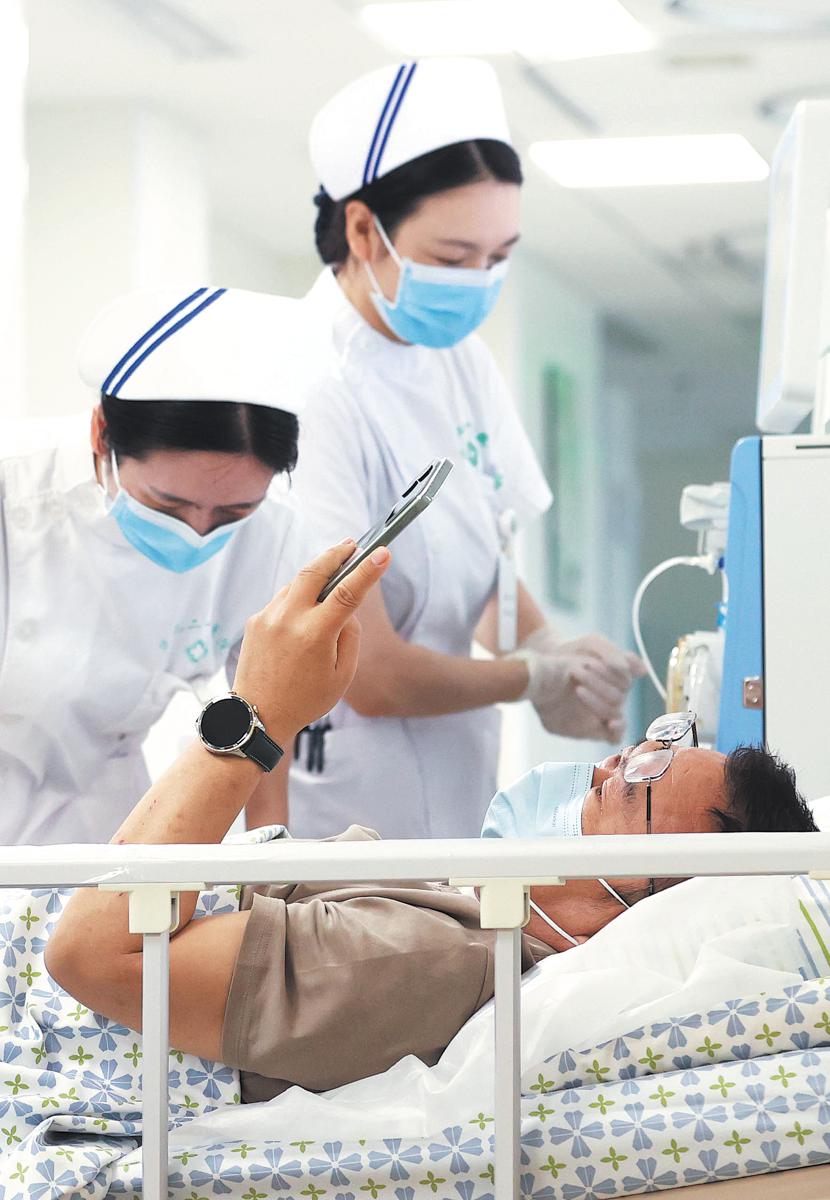
Wang reads essays during a dialysis session in Changsha. HE SHUYUAN/FOR CHINA DAILY
Unbroken spirit
Those around Wang considered his survival a miracle. His return to work came as yet another surprise. He applied for a defense research project immediately after his return.
When they visited Wang in the hospital, his colleagues and students all hoped that he would return to them. Wang said that knowing he was still needed gave him the determination to return.
"My goal has never changed," he said. "Only the way I pursue it has."
He continued to travel alone on business, attend academic conferences, and mentor his students. Those who work with Wang said he has always insisted on self-reliance, never asking others for help as long as he was capable of doing something himself.
To support him, the university installed wheelchair ramps at the entrances to his office building and the campus canteen. Instead of using an electric wheelchair, he insisted on using the manual one to help him exercise more.
Chen Liqian, a professor at the university on Wang's team, said Wang had become even more focused on his work since the illness."He often points us to papers that are closely related to our research, papers we hadn't noticed yet, but he already had," Chen said.
In 2021, Wang was diagnosed with kidney failure. He now undergoes four-hour dialysis sessions three times a week. Yet instead of slowing down, he said he wants to make the most of the time he has. Even during dialysis, he reads academic papers and attends online meetings. "For him, reading papers is a form of rest," his wife said.
On days when he does not undergo dialysis, Wang keeps to a disciplined routine: arriving at the university around 7 am, taking a short break at noon, returning to work at 2 pm, and heading back to the hospital in the evening."Even on holidays, you can usually find him in his office," said Huang Zhen, his driver.
The researcher currently supervises more than 20 master's and doctoral students. Although his own time has become increasingly precious, he remains generous in sharing it with them.
Zhao Jing, one of his students, said Wang's office door is always open for one-on-one discussions. "His smile puts me at ease whenever I run into difficulties in my research," she said.
Fan Kai, one of Wang's master's students, said his mentor's wheelchair soon faded into the background. "Whenever we discussed research, I hardly even noticed he was in a wheelchair," Fan said.
The most noticeable change may be in his diet. According to Wang Ting, who has known Wang Ji for more than 30 years, Wang Ji used to be a food lover, with a particular fondness for the rice noodles sold near the campus. However, since being diagnosed with kidney failure, he has had to strictly control his intake of water and food. To make drinking water more enjoyable, Wang bought a machine for the office to make sparkling water.
"His illness never changed who he was. Even in adversity, he remained as kind, optimistic and passionate about life as he had always been," said Wang Ting.

Wang leafs through books at the university library in May. FAN JUNWEI/FOR CHINA DAILY
Vision and mission
On Wang Ji's desk, two monitors stand along with a keyboard. There is also an electronic display screen for discussions with his team.
The office is modest, but the work carried out there has long been at the forefront of the field. Since the 1990s, Wang has devoted himself to software technology research, a pursuit he describes as his lifelong dream. High-confidence software technology is part of it.
Wang Huaimin, a professor at the university and an academician at the Chinese Academy of Sciences, said he was impressed by Wang Ji's pioneering spirit and his exceptionally broad research perspective. "Even after returning to work, he has maintained a vigorous and ambitious mindset, demonstrating remarkable persistence and resilience," he added.
Wang Ji said the university's spirit and traditions have profoundly shaped his career. As the birthplace of China's first supercomputer and a leader in the country's supercomputing development, the university instilled in him the importance of technological self-reliance.
"We cannot rely on technologies controlled by others," he said. "Key and core technologies must be mastered by ourselves."
Established in 1953, the university has overcome a large number of cutting-edge technological challenges and achieved a series of breakthroughs in the research and development of advanced weapons and equipment.
As the chief technical expert, Wang led his team in developing a project that won the First Prize of the Military Science and Technology Progress Award in 2025.
Wang encourages students to base their research on reality instead of intuition. "Scientific research is not a sprint to chase the latest trends, but a marathon that keeps pace with the nation's needs," he said. So far, Wang has trained more than 120 master's and doctoral students in the field.
As defense systems undergo an intelligent transformation, Wang and his team are focusing on the reliability of artificial intelligence, aiming to ensure that AI can better serve the country's major strategic needs.
Though he cannot take part in conventional warfare, Wang said, "I can still stand on the front line of high-level scientific and technological self-reliance, forging shields with code."
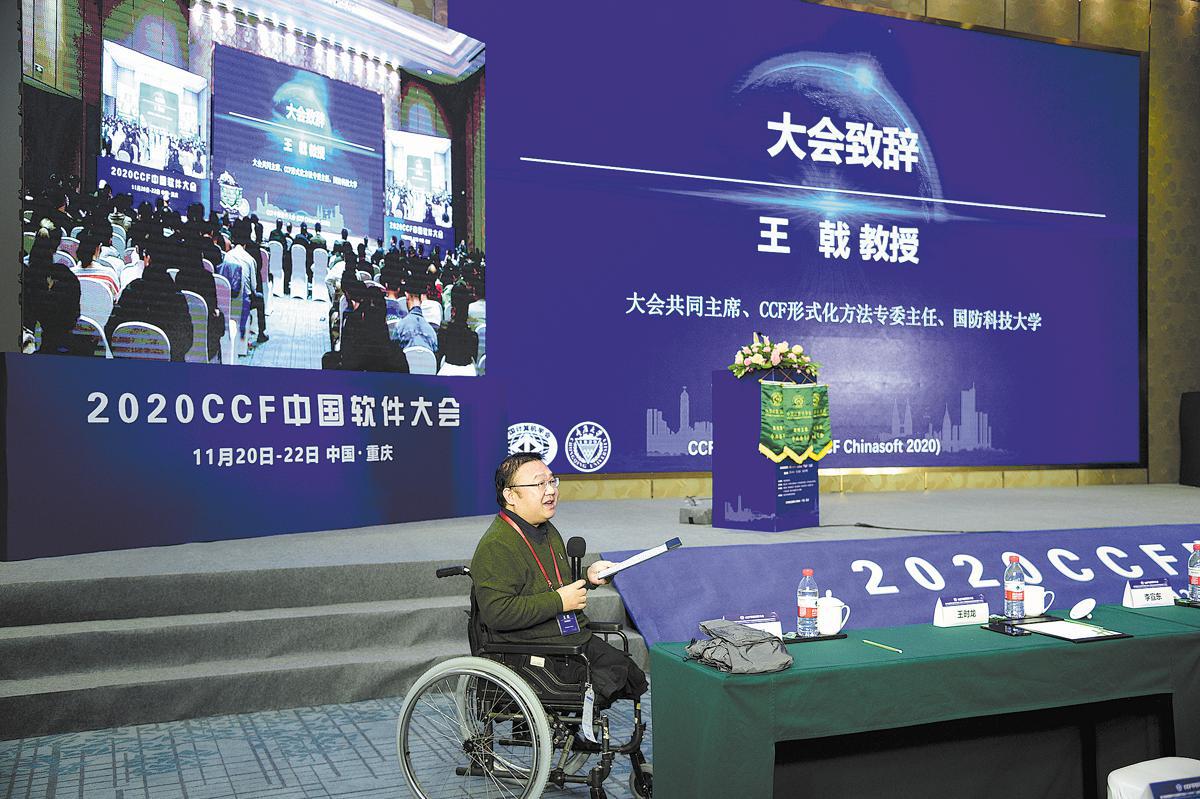
Wang gives a speech during the 2020 CCF ChinaSoft conference in Chongqing. ZHU MINGHUI/FOR CHINA DAILY
RESUME
A member of the Communist Party of China, Wang Ji was admitted to the National University of Defense Technology in 1983 and joined the military in April 1990. After receiving his doctorate in 1995, he stayed at the university and has worked there ever since. He is currently a researcher and doctoral supervisor at the university's College of Computer Science and Technology.
In 2003, Wang published one of the earliest academic papers in China on high-confidence software engineering technology, systematically establishing the discipline's theoretical framework and technical system. In 2004, he launched the country's first graduate course on high-confidence software technology. In 2015, he helped promote the establishment of the Formal Methods Technical Committee of the China Computer Federation.
Wang has received the first prize of the Military Science and Technology Progress Award and the second prize of the National Science and Technology Progress Award. He has been awarded one second-class and two third-class individual merit citations. Last year, he was named a national model of self-reliance. Earlier this month, he was honored as a national "Role Model of the Times".
Wang's wife, Huang Chun, is a core member of the Tianhe supercomputer compiler team at the National University of Defense Technology and a recipient of the National March 8th Red-Banner Pacesetter award. Their family was named a "national five-good civilized family" in 2016 and was recognized as one of the "third cohort of national civilized families" in 2025.
Zhang Zhaoxing and Yan Jincontributed to this story.
Editor:Zhou Jinmiao